
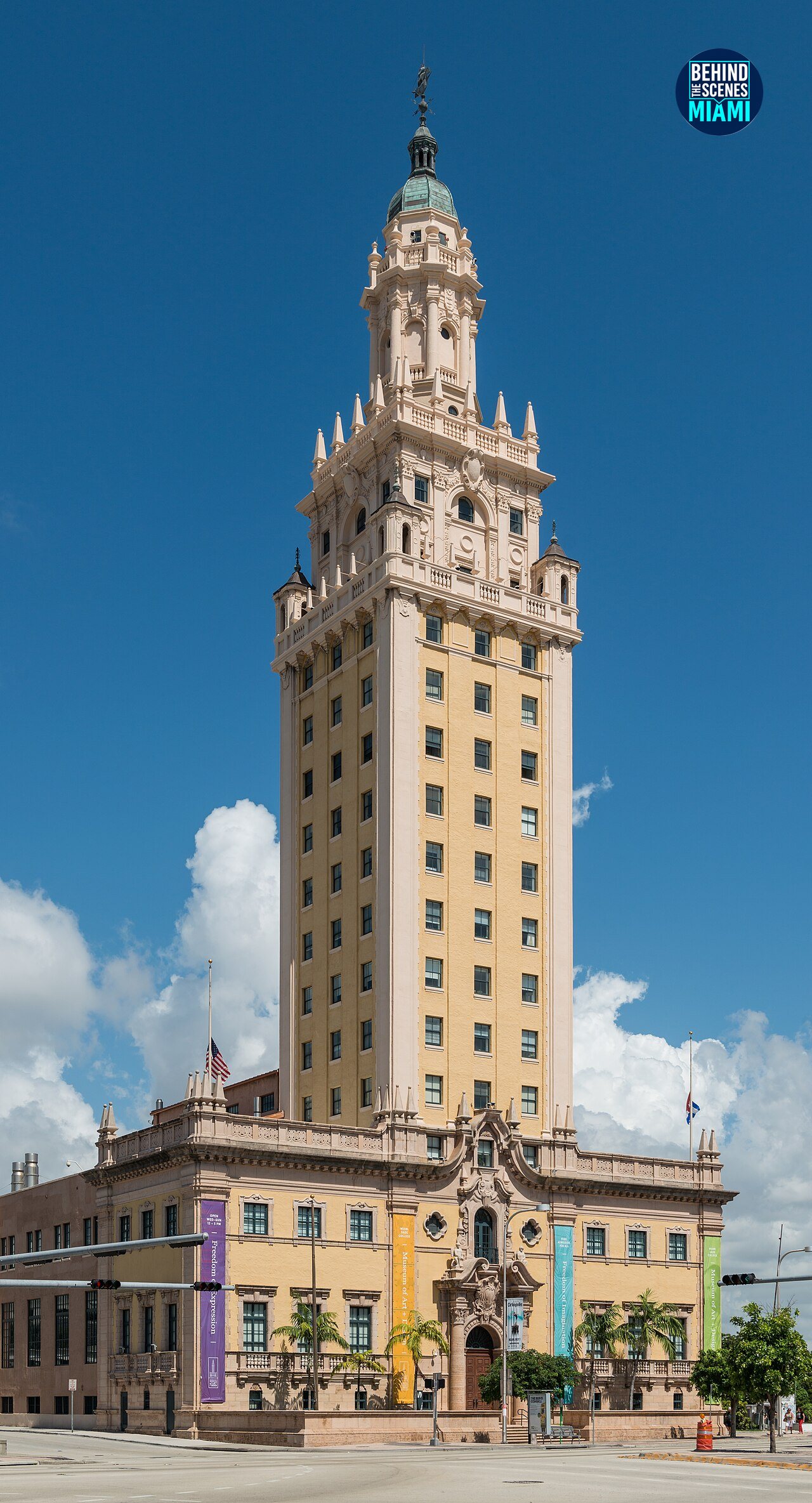
Freedom Tower
The Freedom Tower is the 255 foot tower at 600 Biscayne Boulevard in Downtown Miami, built in 1925 as the headquarters and printing plant of The Miami News and reborn in the 1960s as the place where the United States government received the Cubans fleeing the Cuban Revolution. Designed by Schultze and Weaver in Spanish Renaissance Revival style, with a cupola modeled on the Giralda of Seville, it is a National Historic Landmark and today belongs to Miami Dade College, which runs it as a museum and cultural center on its Wolfson Campus.
After a restoration of 25 million dollars, the tower reopened on September 16, 2025, one hundred years after it rose over the bay.
A newspaper tower
The tower rose in 1925 for The Miami News, the afternoon newspaper owned by former Ohio governor James M. Cox, and it carried the paper's presses and offices behind a facade of arches, balconies and a beacon lit cupola. For four decades it was one of the two towers that defined the young skyline of Miami, a piece of Seville set down on Biscayne Bay.
The Miami News left in 1966 to share a new plant with The Miami Herald, and the building's second life, the one that gave it its name, was about to begin.
The tower of the exile
In the 1960s the federal government took over the tower to process and document the refugees arriving from Castro's Cuba, and to give them medical and dental care on their first days in the United States. For the Cuban community of Miami the building became El Refugio, the refuge: the first American address of hundreds of thousands of exiles, and the symbol of the city's second founding.
That role is why the tower was added to the National Register of Historic Places on September 10, 1979 and designated a National Historic Landmark on October 6, 2008. When Celia Cruz died in 2003, more than 200,000 people came to the tower to pay their respects.
Memorial and college
The government sold the building to private buyers in 1974, and in 1997 the family of Cuban American businessman Jorge Mas Canosa bought it for 4.1 million dollars, restored it and turned it into a memorial to the exile, with a museum, a library and the offices of the Cuban American National Foundation. Inside, the Grand Hall on the second floor holds the New World Mural 1513, painted in 1988 by the Miami Artisans as a recreation of the ruined 1926 original.
In 2005 the Terra Group bought the tower and donated it to Miami Dade College, with the condition that the college keep the Cuban exile experience alive inside it. The college, which also brings the city the Miami Book Fair and the Miami Film Festival, made the tower its museum and cultural center.
The centennial tower
The tower closed in July 2023 for two years of structural and interior repairs and a full exterior restoration, funded with 25 million dollars from the State of Florida. It reopened to the public on September 16, 2025, in its centennial year, with its exhibitions on the Cuban exile experience renewed.
The tower stands across the boulevard from the Kaseya Center, and the Metromover stops at its own station, Freedom Tower, on the Omni Loop. On the nights when Miami marks a historic moment, this is the building the city lights.
Official site: mdc.edu
Sources & references
See also
Reviews (0 reviews)
No reviews yet. Be the first to review this place.